The Newsroom Before the Modern Byline
The newsroom before the modern byline took shape around print production and editorial authority. See how those arrangements differed from today’s credits.
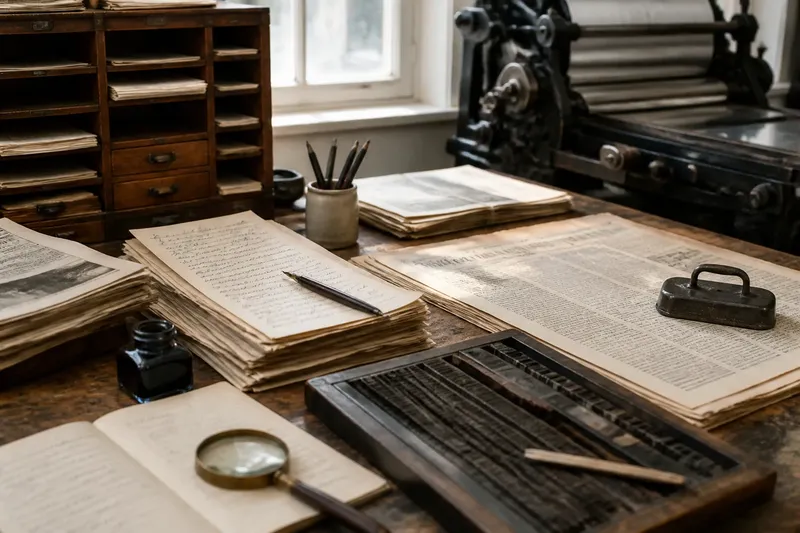
What did a newsroom look like before the modern byline? The newsroom before the modern byline is best understood through the work that had to be done: gathering copy, deciding what to print, preparing pages and getting them into circulation. The details varied by publication and period; the broad account here describes functions, not a single universal newsroom.
For a reader, that distinction matters. A newspaper could speak in the name of its title or editor without routinely naming each writer. The absence of a byline tells us about how credit was presented, not whether reporting or editing took place.
Who spoke for a newspaper before bylines?
In many earlier print settings, the publication itself was the most visible identity attached to a piece. An editor’s name might also carry weight, particularly where the editor selected material and shaped the paper’s character. Individual authorship was not always displayed in the way readers now expect.
That arrangement should not be mistaken for a neat division between anonymous writers and a single all-powerful editor. A publication might print letters, contributed essays, reports and material supplied from elsewhere, each with different origins. Without a named credit, the reader may not be able to distinguish those paths from the page alone.
Historical claims need care here: newspapers differed by place, ownership, format and time. Treating “the old newsroom” as one fixed institution turns a useful question about credit into an invented uniformity.
How did print production shape newsroom work?
A print issue had to be assembled as a physical object. Information arrived in forms that needed selection and preparation; copy had to be fitted to available space, and pages had to be composed before printing. The people responsible for those tasks might work closely together or hold more distinct roles, depending on the publication.
Editors could choose what appeared and revise material. Writers and reporters supplied copy; compositors arranged type for the page, while printers operated the press. These are descriptions of functions, not a claim that every publication used the same titles or workflow. A small paper could combine duties that a larger operation separated.
Tools shaped the points at which work accumulated. Handwritten copy needed to be read and prepared; type and page layouts imposed their own constraints. Later tools changed the pace and form of production, but they did not erase the underlying editorial questions: what to include, how to present it and who had authority to decide.
What changed when names became more visible?
As individual credits became more familiar in some kinds of news, readers gained a visible clue about authorship. That did not turn a byline into a complete record of production. An editor could still alter structure or wording, and a report could still depend on contributions from other people or organisations.
The contrast is therefore not “anonymous past” versus “transparent present”. It is a change in what the page commonly makes visible. A newspaper title, an editor’s name and a reporter’s byline each point to a different kind of association; none, on its own, describes every decision behind publication.
How did the print workflow differ across publications?
Consider three broad arrangements. They are useful for comparing tasks, not for assigning every historical paper to a tidy category.
- A compact local paper: If the same editor selects items and revises copy, then the visible editorial authority may sit with that editor; if the paper’s records or masthead show separate staff, then treat the work as divided rather than assuming one person did everything.
- A larger daily paper: If reports arrive from several writers and are fitted to a common issue, then selection and page preparation become distinct coordination tasks; if surviving credits identify a particular contributor, use that evidence for authorship without assigning every edit to them.
- A paper carrying contributed material: If an item is marked as a letter or contribution, then distinguish the contributor’s words from the publication’s decision to print them; if the item has no such indication, leave its origin uncertain rather than supplying one.
- A publication relying on shared copy: If the same dispatch or wording appears in several papers, then consider shared material as one possible explanation; if no source credit or archival evidence supports that reading, do not claim the papers used an agency service.
- A page assembled under tight space constraints: If a report is shortened or moved to fit the issue, then its printed form may reflect editorial and production choices as well as the writer’s copy; if no earlier version survives, the precise changes cannot be reconstructed.
- A paper with a prominent editor: If the editor’s name appears prominently, then it supports a claim about public association with the paper; if the question is who wrote or revised a particular item, seek item-level evidence instead.
Say you are examining an invented, hypothetical local-paper page. The starting evidence is a report with no personal byline, a masthead naming an editor, and a separate item clearly marked as a reader’s letter. First, record those three observations without assigning an author to the report. Next, treat the editor’s name as evidence of the paper’s stated editorial identity, not proof that the editor wrote the report. Finally, keep the letter distinct from the report because the page labels its source. The resulting account is modest but defensible: the publication identifies an editor, distinguishes a contribution, and leaves the report’s individual author unresolved.
What can a historical credit establish?
A credit is evidence for the association it states. A named contributor can support an attribution to that person; a publication name can show where an item appeared. Neither alone settles who selected, revised or prepared the item.
When examining an old page, start with what is printed: the masthead, any byline, labels such as “letter”, and the placement of the item. If an archive catalogue or other contemporary record provides further context, distinguish that information from what the page itself says. Keep uncertainty visible where the evidence stops.
This approach also helps avoid a familiar trap: projecting present-day job titles backwards. A historical editor, reporter or compositor may not have had duties identical to those associated with the same word now. Describe the task or evidence where possible, rather than assuming the title carries a fixed modern meaning.
What do readers ask about the newsroom before the modern byline?
Did every newspaper have an editor?
Publications needed decisions about what to print, but their staffing and titles varied. If a surviving masthead names an editor, report that; if it does not, avoid filling the gap with an assumed job title.
Does an unsigned report mean nobody knows who wrote it?
No: it means the item does not identify an individual writer on the page. Other records might provide context, but the absence of a printed name is not itself evidence that authorship was unknowable.
Were compositors part of editorial work?
Compositors prepared type and pages for printing, a production function with consequences for how copy appeared. Whether they also made editorial decisions cannot be inferred from the job label alone; use evidence about the particular publication or task.
Can an editor’s name identify the author of an unsigned item?
Not by itself. A masthead credit establishes the editor’s public association with the publication, while an unsigned item leaves its individual authorship unstated unless other evidence supplies it.
Why does this history matter when reading credits?
The newsroom before the modern byline reminds readers that a printed item could emerge from several kinds of work while displaying only a narrow slice of its origins. It also cautions against imagining a single historical model: publications arranged authority and production differently, and surviving pages do not always disclose the process.
When you read an old newspaper, separate what the page names from what you infer about its making. That simple distinction lets a masthead, an unsigned report and a marked contribution each contribute what they can—without asking any of them to tell a story they were never printed to tell.